
Walking defines us as humans. You walk first and then you talk, it is a matter of autonomy. The idea of autonomous individuals is important. Taking kids to school – teaching them how to be independent …Walking is a way of social interaction; it is an opportunity to engage … is what makes our relationship with the city.
David Vale
Providing good walking space is more than a pavement for pedestrians alone. People walk where people are. That is one of the most important activities in public space, to meet, see and watch other people. Therefore, a good street provides conditions: wide pavement areas, benches, shades, lighting, other urban furniture, and public accessible activities on the ground floor level. All of these contribute to making streets not only a space of flow, but also a social space to stay. Of course, social and traffic safety are basic necessary conditions.
The network for walking does matter. Streets take a fundamental role in this: creating walkable routes and local accessibility to all urban spaces.
If the network has a fine structure, it offers more variety and freedom in possible walking routes. Shorter and faster is not always the natural choice.Sometimes, people choose for unintentional detours to explore attractive urban or green areas, to find the opportunity for sojourning, to stay, to stop, and enjoy the pathway.
Space for street walking demands a good design. Enough space and crossing with prioritisation for pedestrians are essential to establish a safe and continuous walking experience on the streets. To make the accessibility to the ground floors of the building fluid and strong (and because of ´social eyes´, also safer), it is preferable to ensure that the street and the ground floor are at the same level. This will enforce the interaction between the public and the private space.
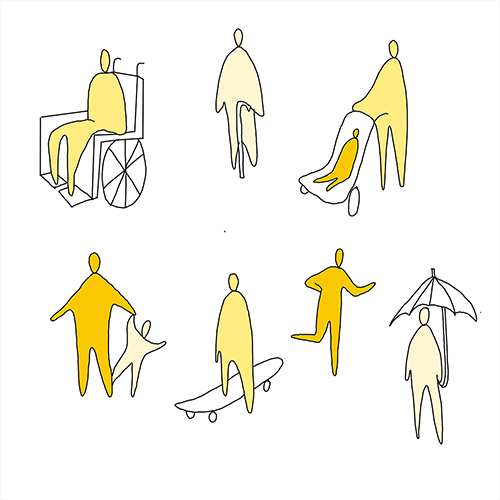
Space to Walk
Walking is a basic need. 1,50m is the universal minimum standard for pedestrian areas (free of obstacles), an essential condition for urban street life, together with safety and continuity of the walking routes. Walking areas can be quite diverse: small and large, functional and attractive, full of shadow or offering plenty of light.
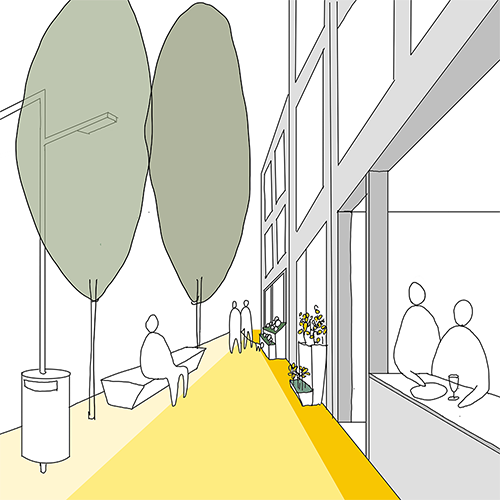
Pedestrian Area
Three zones can be distinct: a transition zone (interaction between public and private space);a free walkable zone; and service zone (urban furniture, lighting, trees, traffic signs).

Fine Network
A fine walking network offers variation in possible routes. People can choose the faster, the liveliest, the attractiveness or the most comfortable route.
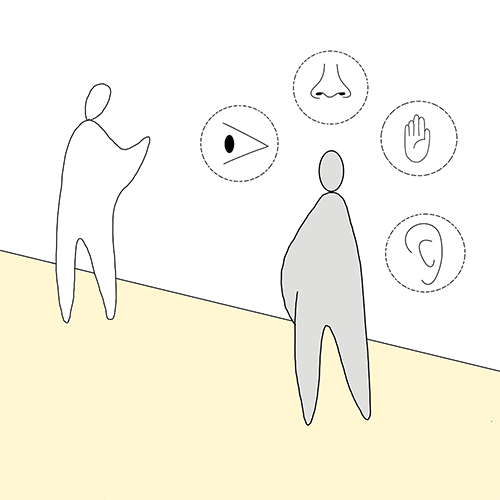
Health Benefits
Walking offers a rich spectrum of social and health benefits, like to meet (watch/talk/touch/feel) and physical activity.
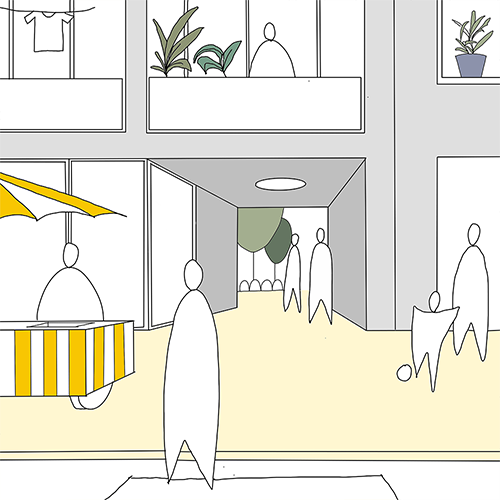
Attractive & Safe
Spaces that are attractive for many people, will often feel safer. A clean space is a sign that people take care of it. Benches, food & shades offer comfortable conditions for enjoying places.
Short-Cuts
Within large building blocks, short-cuts provide direct connections between different streets.