Location
Copenhagen, Denmark
Project
DE Urbanisten + SLA
Programme
City of Copenhagen, Technical and Environmental Administration
Date
2019
Area
13.500 m²
Dimensions
30 m Width; 783 m Length
Surfaces
2.970 m² permeable; 10.530 m² impermeable
Ground floor
40% Commerce; 45% Dwellings; 10% Offices; 5% Others
About
Located in the Nørrebro district of Copenhagen, Rantzausgade has been transformed from a traditional traffic dominated corridor into a contemporary “rain street” prioritising people, climate resilience and local urban life. Historically part of a working class neighbourhood known as the “rhubarb quarter”, the street was originally characterised by small scale industry and retail, but gradually became dominated by vehicular traffic and associated noise.
The project, commissioned by the Technical and Environmental Administration of the City of Copenhagen, was developed by DE Urbanisten in collaboration with SLA. Their approach reframed Rantzausgade as a continuous urban landscape rather than a transport corridor, integrating mobility, ecology and public life into a single spatial system.
A central design contribution of DE Urbanisten was the reorganisation of street hierarchy through carriageway narrowing and the reallocation of space to pedestrians and cyclists, establishing a calmer and more permeable urban structure. In parallel, SLA developed a landscape and climate strategy based on distributed stormwater management, using tree planting, rain gardens and permeable surfaces as an integrated infrastructural system.
Together, the design team introduced a “rain street” typology in which climate adaptation is embedded directly into the public realm. Rantzausgade functions simultaneously as a mobility corridor, a social space and a water management infrastructure, capable of retaining and slowing stormwater during heavy rainfall events while supporting everyday urban life.
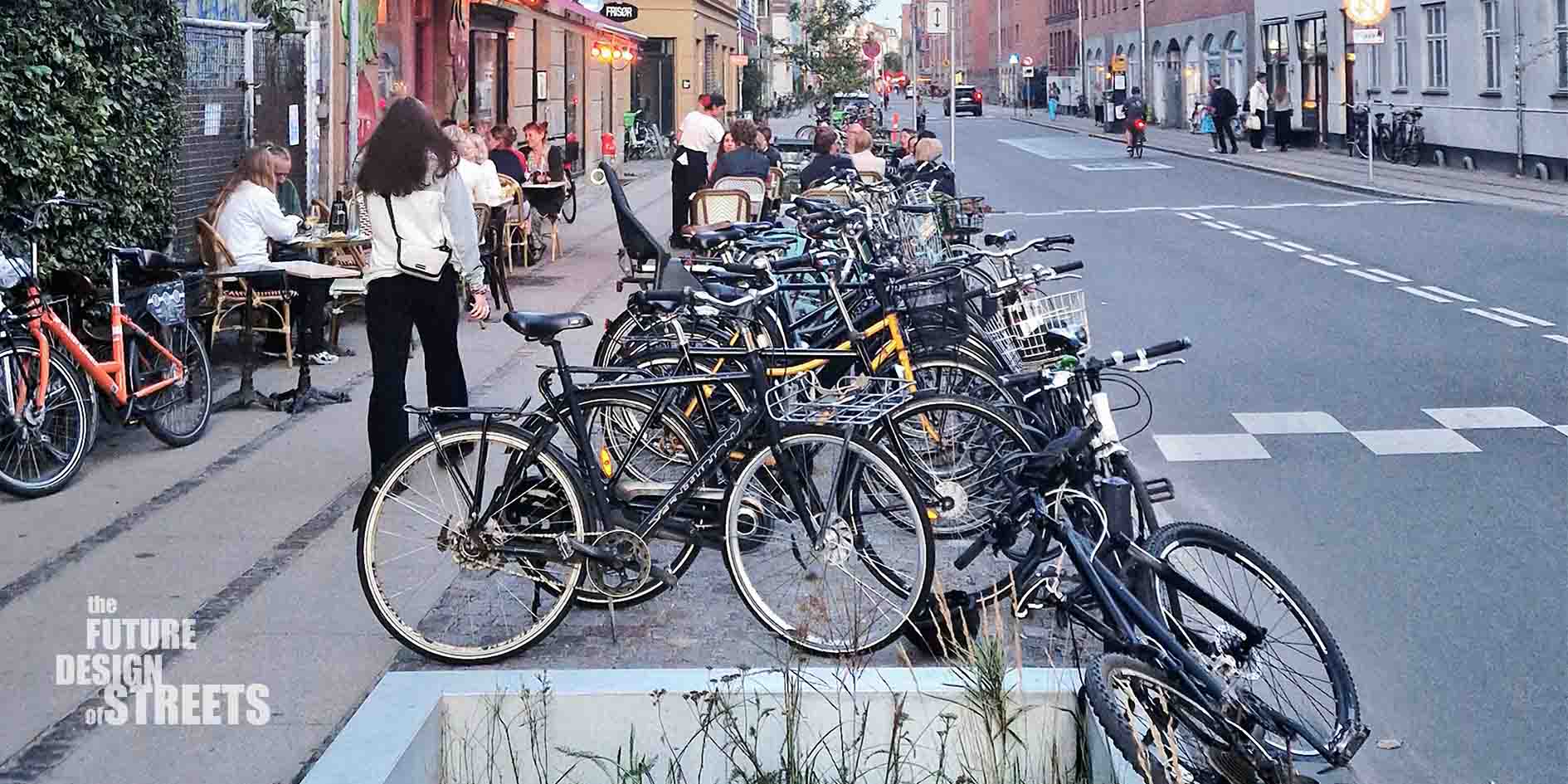
The project also introduces a flexible spatial structure based on adaptable use zones. These areas operate as loading bays in the morning, market spaces during the day and café terraces in the evening, reinforcing a dynamic and locally driven street life. Modular furniture and planting systems allow residents and businesses to actively shape the street’s everyday use, strengthening its role as a shared civic space rather than a fixed traffic corridor.
In parallel with its environmental performance, the redesign prioritises social activation and neighbourhood identity. By reallocating street space from cars to active modes of transport and creating opportunities for informal gathering, the project contributes to the regeneration of a dense mixed use district. Today, Rantzausgade stands as an example of Copenhagen’s broader strategy of integrating climate adaptation, mobility transition and human centred street design into a single coherent urban framework.
Photos


Map